Recently I completed the last set of changes I wanted to make to get this website back into basic shape. A vertical slice, if you will. When I started this project log I thought it was going to take much longer, and if I included other things as part of the vertical slice such as a super-impressive UI, it probably would have. But I ended up making two decisions that helped me complete this revamp much faster:
- I decided to focus on a pure vertical slice. There were other things I could have done first before considering this project “finished”, such as a more impressive UI with different colors, or a gallery feature for my notes and projects. But then I remembered that, even if a total scope seems small, life has a way of making each step take much longer than expected on top of balancing it against other work I needed to do. With that, I decided to go just as minimalist as my sites tend to be - only the essentials to clean up the website and get it live. Now that that’s done, I can add one feature at a time onto a solid base, and routinely get that feel of “completing” something.
- I leveraged AI tools to quickly research and prototype changes which helped me turn around the project a lot faster.
So now, of course, we need to get into the AI topic.
It’s February 2026 as I write this. There’s a lot going on with AI that I’m not qualified or knowledgable enough to talk about, especially since a lot of this information at first glance is coming from a variety of sources (usually from articles designed to farm engagement over providing solid, factual claims). As such, I’m only going to talk about AI from the perspective of actually building software.
Here’s my view:
-
AI assistants have been great for automating rote work, looking up syntax, and creating quick templates. I’m not familiar with Go or the templating language Hugo runs on. It’d be easy to look up existing code and themes that mimic what I want, of course. But using an assistant not only created starting templates for me to work off of, it was able to reference Hugo documentation to teach me more about how the framework approaches things like partial layouts that can repeat on multiple pages. This way, I was quickly able to make, test, and verify changes faster than pulling everything up on my own.
-
It’s that teaching part that’s also been helpful. An assistant’s ability to break down and restate concepts in simpler terms using analogies has been huge. I typically have a hard time grasping a concept if it’s using more complex terminology or if the explaination is written abstractly like those math problems that start “given p and n”, etc. When I was recently reviewing object-oriented programming and system design concepts, having the assistant translate the examples into real-wold examples did wonders for my understanding.
That being said:
-
Right now as I write this, AI is being aggressively marketed as a magic do-everything tool. It ain’t. It’s way too new to succesfully replace an entire worker, be a friendly or romantic companion, teach a comprehensive course, et cetera. It especially shouldn’t be trusted wholesale with shippable production code (sorry, Microsoft, we’ll stop calling it slop when you stop making it).
-
It especially shouldn’t be used to diagnose illnesses on its own. Please don’t be that guy.
-
Also remember that models are scraping from the internet for information, especially places like Reddit. There’s no guarantee that every single bit of information it pulls is true and verified. And this is even before the chance of AI getting confused and creating non-deterministic answers that are flat-out wrong. You’ve got to take everything with a grain of salt, because who knows if it’s referencing a faulty source?
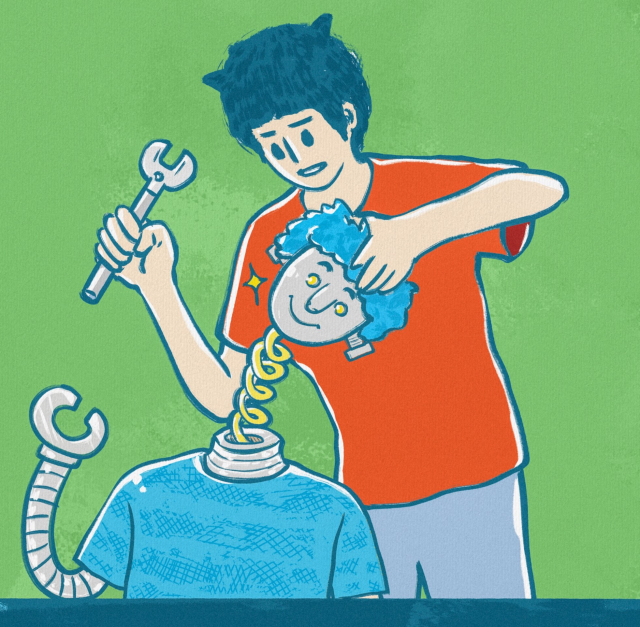
Of course, in five years AI’s going to be radically different and many of these flaws might be ironed out. We’ll have to see. For now, the key takeaway is to not lean on AI as a replacement for thought. It’s a tireless but ultimately inexperienced junior worker. Leverage it to get stuff done faster (and it’s expected now that every developer needs to be using it to keep up, much like using an IDE) but don’t let it take the place of developing your own critical thinking and logic skills. And while you’re at it, you ought to keep being a skeptic too, whenever someone tries to sell you on how amazing AI is with [whatever niche that marketing is trying to target today], please-don’t-look-at-the-source-code.
This post wasn’t written with AI, by the way. None of the posts written on this website are. I don’t use a lot of RAM and water to write these, just my own wetware. Could stand to dry it out sometime, though.