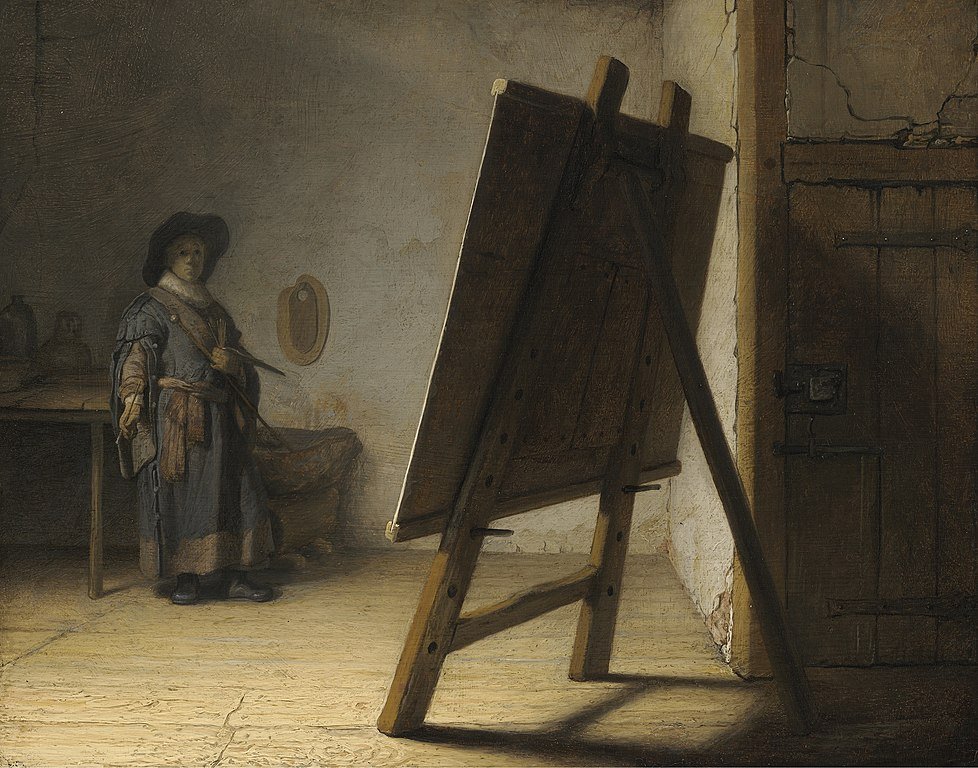
The Artist in his Atelier - Rembrandt, 1629
Recently I used Cursor.ai for the first time, and with it, I built a simple AI agent to automate a repeating text-editing task. Nothing complex. Still, it was fascinating to plan out the grammar rules and procedure to follow in Markdown files, and then watch it refer to - and execute on - those Markdown files to instantly build a Python script to do the job. Up until that point I had been merely reading about agentic AI development, but that firsthand experience helped me understand why this paradigm’s taken off.
I can see how industries are going to lean heavily towards this style of development going forward. At the same time, the advice I’ve gotten so far advocated not completely handing off feature development to the machine. I think we’ve seen what happens when you do that without much thought (hi Microsoft). Instead, it’s more about directing a junior developer to write code and then reviewing its work to make sure it hit all the rules and design decisions you expect. The story’s been the same - a human still needs to sit at the computer, making the higher-level choices in system architecture to ensure code is modular and maintainable.
But I don’t think it’s going to remain that way. AI is getting smarter and better every day. It’s wedging into countless workflows (for better or for worse) and amplifying the pressure to “fail fast” and build quickly. And yes, right now, you need a human present to make sure the agents are driving the right way. But at what point will the agent be able to make these high-level decisons on its own? Five years from now? Maybe even two or three? At what point will we be expected to hand over the high-level design and insight to the magic machine? And then what will we do?
When I was building that agent, I had to wonder. Where is the dividing line between delegating and stagnating? How much will we be able to pass to a tool while still being able to challenge ourselves and grow - not just because it’s required, but because it’s good for us? You hear stories about vibe coding where non-developers completely trust an AI agent to build something, without understanding how or why the agent wrote the code a certain way, and whether or not it’s the best design choice. But in five years, will this gap be erased? And that also makes me think - will the professional world even allow you to learn this, or will you be expected to pump inputs into the design AI, and then the coding AI, and keep your mouth shut while it’s working?
I don’t have a good answer for this. Of course, as time marches, people will always find ways to do things faster and more effectively. Once valuable skills will be outdated, or rendered non-essential due to technology. Illustration used to be a much higher paying field until the invention of the camera knocked that down a few pegs. But that doesn’t make illustration an invalid skill to learn. It’s a physical act, the craft of bringing pencil and ink and paint together on paper, interacting with and understanding the physical world not with technology but with your own eyes and hands to produce something that resembles it. It’s not “efficient” or “easy”, as the ten thousand AI providers might claim (or saying doing it that way will leave you “behind”). but there’s something to be said about getting into the muck, be it art or code, and doing it without the tools - just your own study and book-notes and understanding, making those primal connections in your brain that an AI explaining a topic can only hope to mimic.
I’m not a Luddite. I’m going to keep using this new technology. Parts of it are cool and useful, and it’s to be expected going forward. But I think after a while we may end up excusing ourselves from a race that was worth running, even only for our own understanding, growth, and fulfillment. That’ll fall the way of the hobbyist, I imagine. After all, people still play with ham radios. Maybe five years from now there will be a Python club devoted to typing out the language on keyboards - real “old-school”.